Nitricity’s Circular Approach to Fertilizer
At Nitricity, we believe in a circular agricultural system that transforms biomass waste into high-value resources, fueling a true circular economy. That means taking what the soil gives us, repurposing it, and returning it in a form that strengthens the next harvest.
Our organic nitrogen fertilizer, Ash Tea, is born from this philosophy. By upcycling local agricultural byproducts, like almond shells in California, we pair them with just air, water, and clean energy to create plant-ready nutrition. California is the world’s largest almond producer, generating hundreds of thousands of tons of almond shell waste each year, which is where Nitricity sees a valuable opportunity for upcycling rather than a disposal challenge. What once was waste becomes the foundation of healthier soils and stronger crops.
Founded in the Bay Area, Nitricity has always been closely connected to California’s agricultural landscape. Almond shells, which were once considered a low‑value byproduct, are now a powerful feedstock helping reduce biomass waste, support decarbonization, and build a circular agricultural economy.
This circular loop does more than reduce waste:
It keeps nutrients local.
It eliminates biomass waste and supports on‑farm decarbonization.
It enables seasonal flexibility, allowing production to align with agricultural rhythms.
It ensures no pathogens or animal inputs are used through our clean, controlled process.
The result is a product that farmers trust, plants thrive on, and the planet benefits from. It’s proof that when agriculture and energy align, we can close the loop on how we grow food.
Our Circular Process
Each step in our circular model reinforces the next, creating a regenerative loop that reduces waste, strengthens soil, and supports farmer resilience.
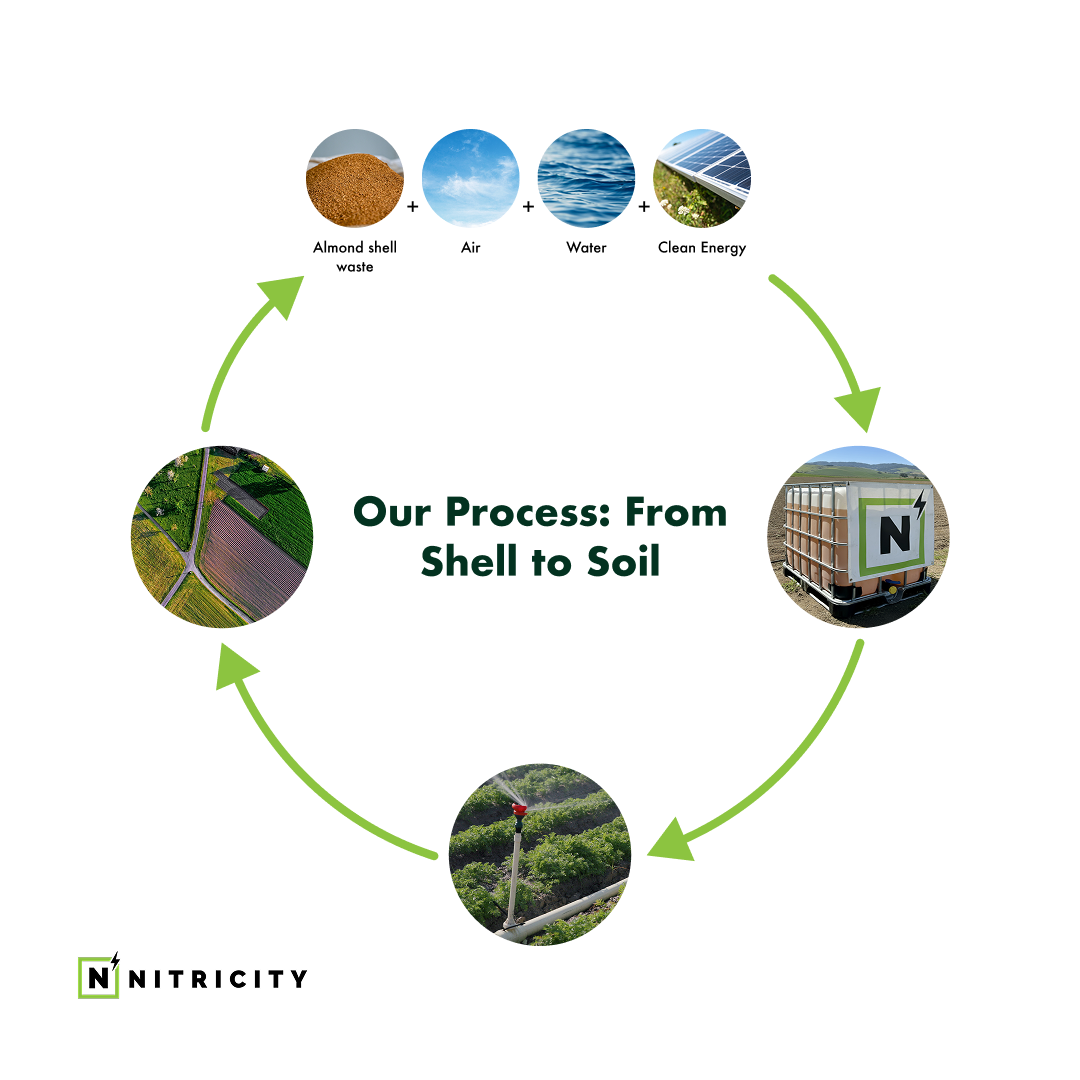
Production based on clean energy
Our process begins with clean energy and agricultural byproducts, combining them with air and water to produce nitrogen fertilizer. This avoids the fossil-intensive Haber-Bosch method and allows fertilizer to be produced locally, reliably, and with far fewer emissions. Using clean energy is what enables the rest of our circular system to stay low-carbon from start to finish.
Upcycling agricultural byproducts into Ash Tea
We transform local agricultural byproducts, especially almond shells, into Ash Tea, our plant-based, organic nitrogen fertilizer. This step diverts biomass waste from landfills and turns it into a valuable farm input. Upcycling gives farmers a climate-friendly fertilizer while reducing waste streams in their own communities.
Designed for modern irrigation and ease of use
Once produced, Ash Tea is clean, soluble, and compatible with drip systems, micro-sprinklers, and other modern irrigation methods. Because it flows easily and contains no pathogens, farmers can apply it precisely when and where crops need it. This completes the loop and returns nutrients back to the same fields that produced the original biomass.
Building a circular bioeconomy
Every part of the process contributes to a larger circular bioeconomy: clean energy powers production, waste becomes feedstock, fertilizer returns to the field and improves soil health. This system keeps value local and creates a regenerative agricultural cycle.
Ready to scale
Nitricity’s circular model is built to grow with farmers’ needs. Local, flexible, and timed to the growing season, it ensures fertilizer is available exactly when farmers need it, without relying on long global supply chains.