
Field Trial: Calcium-Fortified Ash Tea Organic Fertilizer Enhances Soil Health, Yield, and Quality in Organic Romaine Lettuce
A commercial field trial was conducted in Soledad, California to evaluate Nitricity’s Calcium-Fortified Ash Tea fertilizer in organically grown romaine lettuce. The study was carried out on decomposed granite soil, a sandy loam medium known for lower water and nutrient retention.
Under these conditions, Nitricity’s Calcium-Fortified Ash Tea organic fertilizer was evaluated as a readily available nitrogen fertilizer source for organic romaine lettuce production. Results from the trial showed that incorporating Calcium-Fortified Ash Tea into the in-season fertilization program improved yield, enhanced crop quality, and supported healthier soil nutrient dynamics by reducing sodium and chloride accumulation in both soil and plant tissue.
Trial Overview
Location: Soledad, CA
Crop: Romaine Lettuce (Duquesne variety)
Product: Nitricity Calcium-Fortified Ash Tea liquid fertilizer
Application rate: 50 lbs N/acre
Trial duration: Mid-August to mid-October (61 days after sowing)
In addition to evaluating crop performance and fertilizer efficiency, the trial also examined how the nitrogen source influenced soil nutrient balance and salt dynamics in the root zone.
Trial Design
The trial was conducted in a commercial romaine lettuce field under organic management on decomposed granite sandy loam soil. Both treatments received identical pre-plant fertilization and drip irrigation management.
After planting, the two treatments diverged in their in-season nitrogen source:
Farmer’s Standard Practice (FSP): Continued nitrogen fertilization using a commercial soy hydrolyzed protein fertilizer.
Nitricity treatment: Supplied in-season nitrogen using Calcium-Fortified Ash Tea.
Both plots received 50 lb N/acre applied at 40 days after sowing (DAS). The Nitricity treatment therefore directly replaced the grower’s typical organic nitrogen input, allowing a side-by-side comparison under identical field conditions.
Yield Results
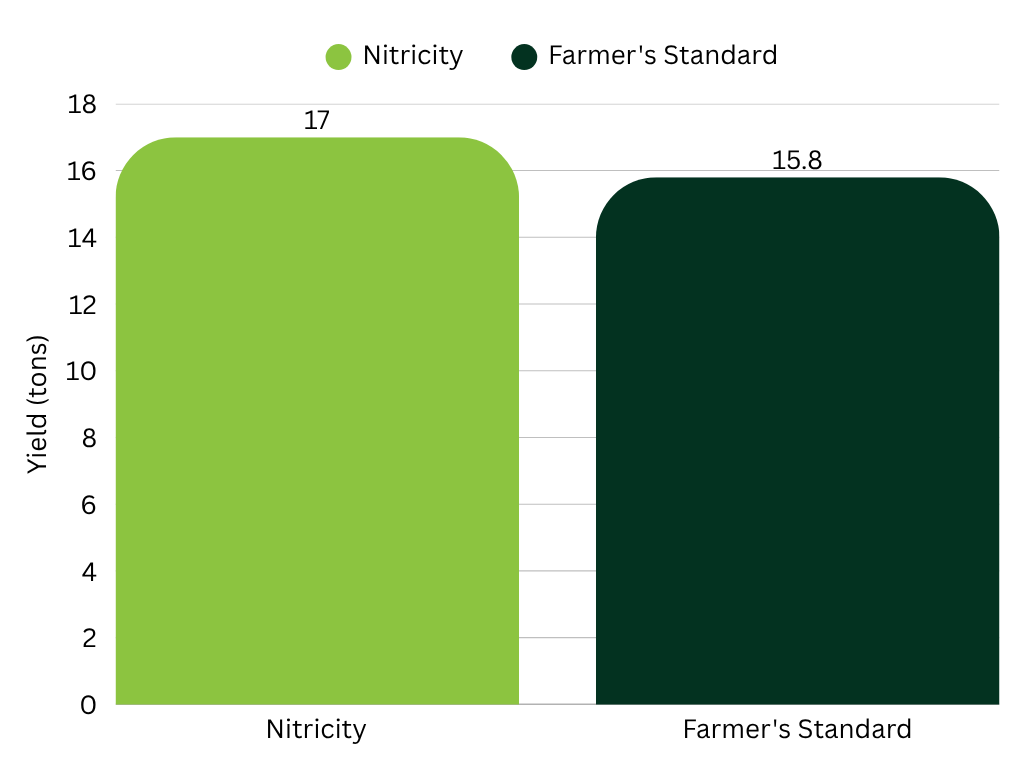
Fig. 1: Nitricity’s Calcium fortified Ash Tea -treated lettuce achieved a higher yield (17 tons/acre) compared with the Farmer Standard Practice (FSP, 15.8 tons/acre), demonstrating stronger crop performance
At harvest, the Nitricity-treated plot produced a higher yield compared with the farmer’s standard practice:
Nitricity: 17.0 tons/acre
Farmer’s Standard: 15.8 tons/acre
This represents a 7.1% increase in yield, demonstrating improved fertilizer efficiency under sandy loam soil conditions where nutrient retention is typically lower.
Improved Crop Quality
Beyond yield, clear visual differences were observed in crop quality. Lettuce grown with Calcium-Fortified Ash Tea exhibited:
More uniform and intense green leaf coloration
Improved leaf crispness and firmness
Greater visual uniformity across plants
These improvements suggest enhanced nitrogen and calcium nutrition, which contribute to stronger leaf structure and overall greater market quality.
Soil and Plant Nutrient Dynamics
Soil and tissue analyses revealed notable differences in nutrient balance between treatments.
Reduced sodium accumulation
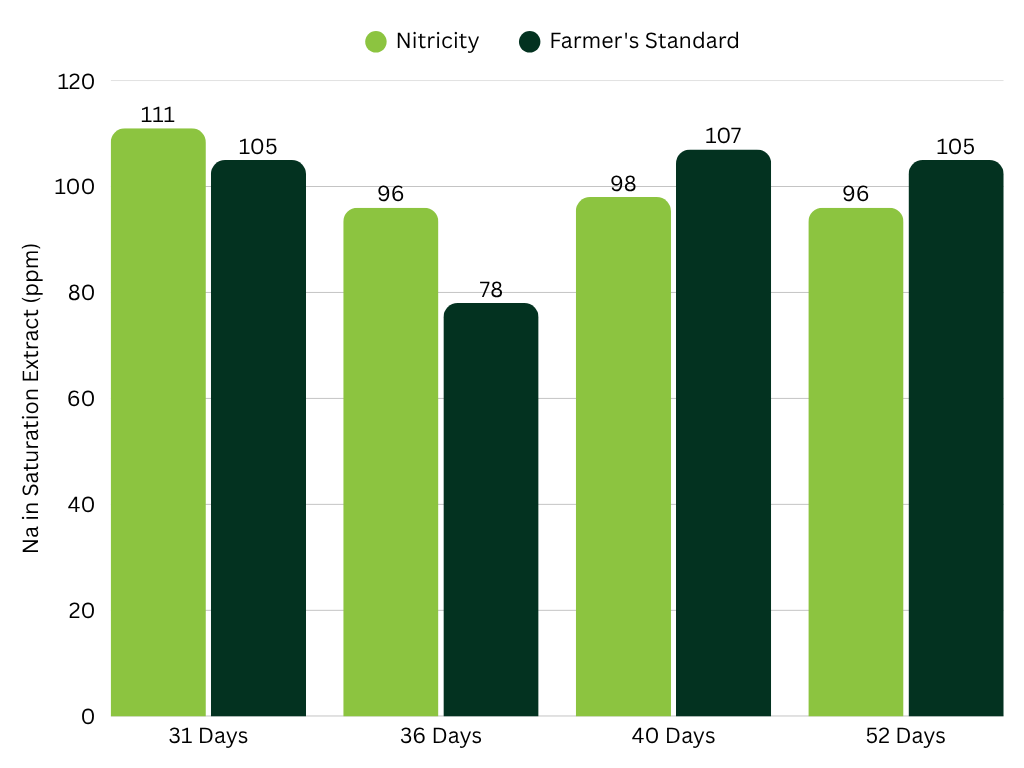
Fig. 2. Trends of soil sodium (Na) concentrations (ppm or mg/L) in the saturation extract from farmer’s lettuce trial on decomposed granite soil. The data reflect the rapidly exchangeable Na in the soil solution. The Nitricity treatment showed a 13% reduction in soil Na from 31 to 52 days, indicating improved soil ionic balance and decreased leaf Na accumulation.
Sodium (Na) levels in the soil saturation extract, representing the readily exchangeable sodium pool, decreased over the course of the trial in the Nitricity plot while remaining unchanged in the farmer’s standard treatment.
Soil Na declined 13% in the Nitricity plot between 31 and 52 DAS (111 → 96 ppm).
In contrast, soil Na levels remained constant in the FSP plot (105 → 105 ppm).
This trend was mirrored in plant tissue. Sodium concentrations in lettuce leaves were consistently lower in the Nitricity treatment:
8% lower Na at 40 DAS
29% lower Na at 52 DAS (1,610 vs. 2,279 ppm)
These results indicate that Calcium-Fortified Ash Tea not only avoided contributing to sodium buildup but may also help reduce sodium uptake by plants and supporting overall soil health and nutrient balance.
Reduced Chloride Accumulation
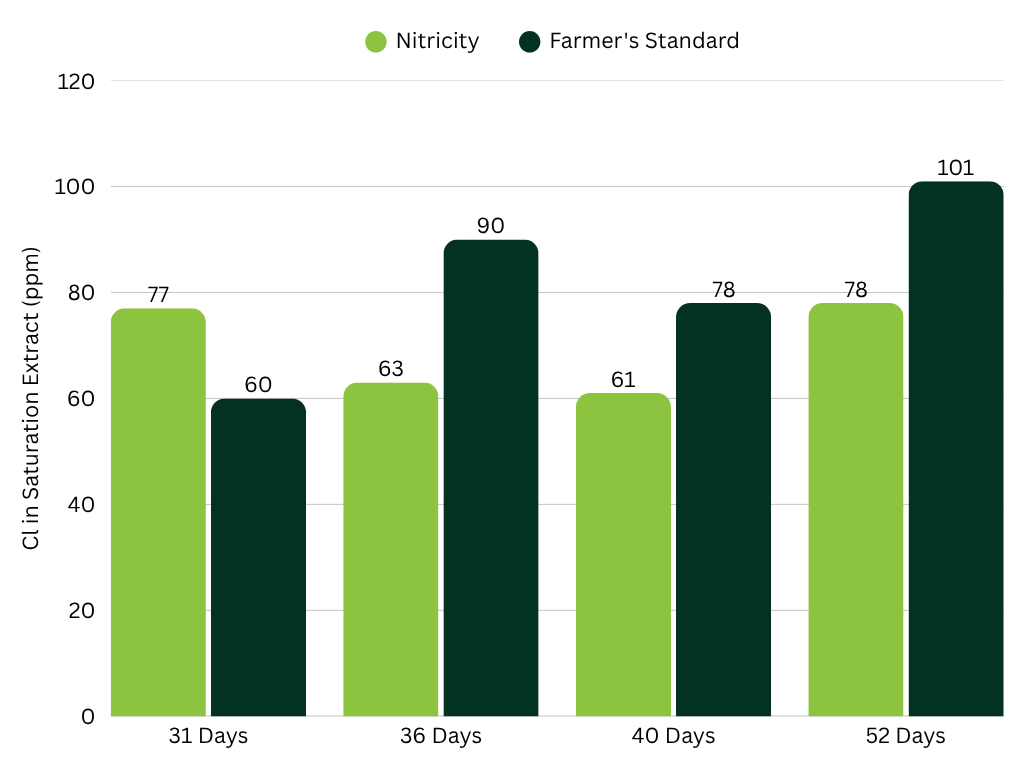
Fig. 3: Trends of soil chloride (Cl) concentrations (ppm or mg/L) in the saturation extract from farmer’s lettuce trial on decomposed granite soil. The data reflect the rapidly exchangeable Cl pool in the soil solution. By 52 days, soil Cl was 23% lower in the Nitricity plot compared with the FSP, corresponding to a 19% reduction in leaf Cl content, suggesting reduced Cl accumulation under Nitricity’s Ca-fortified Ash Tea treatment, leading to less osmotic stress for the crop.
Chloride (Cl) dynamics in the soil saturation extract followed a similar pattern. Soil Cl concentrations remained lower in the Nitricity plot throughout most of the crop cycle while increasing in the farmer’s standard treatment.
By harvest, soil Cl levels were 23% lower in the Nitricity treatment (78 vs. 101 ppm).
Leaf tissue measurements showed a corresponding reduction in chloride accumulation:
19% lower Cl concentration in lettuce leaves at 52 DAS (11,430 vs. 14,168 ppm).
Together, these findings suggest that Calcium-Fortified Ash Tea improved salt management in sandy loam soils by maintaining better ionic balance and reducing osmotic stress on plants.
Key Takeaways using Calcium Fortified Ash Tea
7.1% higher yield compared with the farmer’s standard practice
Improved crop quality, including leaf crispness and color uniformity
Reduced sodium and chloride accumulation in both soil and plant tissue
Improved nutrient balance and reduced osmotic stress under sandy soil conditions
This field trial demonstrates that Nitricity’s Calcium-Fortified Ash Tea can help maintain balanced soil conditions while improving productivity and crop quality in organically grown romaine lettuce, particularly in sandy loam soils. Soil analyses showed that the Nitricity treatment reduced sodium and chloride accumulation in the root zone, improving ionic balance and helping limit temporary salt buildup that can contribute to osmotic stress in coarse soils.
Replacing conventional in-season organic nitrogen inputs with Calcium-Fortified Ash Tea also resulted in higher marketable yield and improved visual quality. Tissue and soil analyses indicated efficient nitrogen uptake and enhanced nitrogen and calcium nutrition, leaving lower residual soil nitrate at the end of the crop cycle.
Overall, Calcium-Fortified Ash Tea provided a readily plant-available nitrogen source as an effective leafy green fertilizer that supported higher yields, improved crop quality, healthier soil, and more balanced nutrient conditions in the root zone.
